Magnolia Heron Pest ControlMagnolia Heron Pest Control

Wildlife Removal New Orleans

Nuisance animals exploit the architectural vulnerabilities unique to Orleans Parish architecture. In neighborhoods like Uptown, Carrollton, and the Garden District, raised center-hall cottages and shotgun homes rest on…
Get My Free Estimate →(504) 389-6488
Wildlife Removal in New Orleans, LA
Quick answer
  • Scope includes on-site structural assessment, humane multi-catch or one-way exclusion trapping, entry point sealing, and waste sanitization.
  • Response windows range from 2 to 4 hours for active interior wildlife breaches, with standard exclusion setups scheduled within 24 hours.
  • Services start at a baseline minimum of $250, with full multi-point architectural exclusion projects ranging up to $1,500 depending on structural height and scope.
  • Targeted species include raccoons, Virginia opossums, eastern gray squirrels, nutria, bats, and non-venomous snakes.
  • Homeowners schedule on-site evaluations by calling (504) 389-6488 to inspect pier-and-beam crawlspaces, soffits, and rooflines.

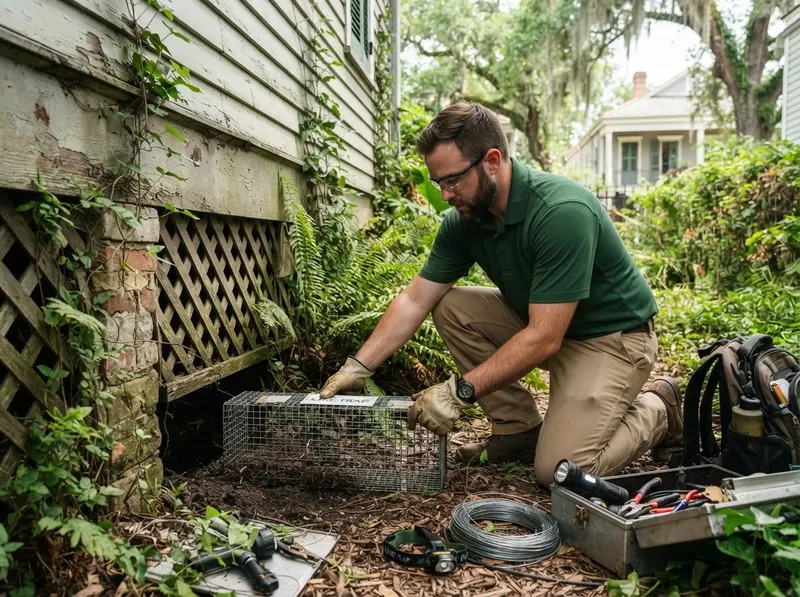
Nuisance animals exploit the architectural vulnerabilities unique to Orleans Parish architecture. In neighborhoods like Uptown, Carrollton, and the Garden District, raised center-hall cottages and shotgun homes rest on brick piers, creating semi-enclosed crawlspaces that offer shelter from the subtropical water table. Raccoons and Virginia opossums tear through rotted cypress lattice, nesting directly beneath floorboards and gnawing into plumbing insulation. In the French Quarter and Marigny, roof rats and gray squirrels bypass slate tiles and enter lath-and-plaster attic spaces via overhanging live oaks, chewing electrical wiring and displacing vintage blow-in insulation.

Humane wildlife exclusion differs fundamentally from standard rodent baiting. Structural exclusion involves the installation of heavy-gauge 1/4-inch galvanized hardware cloth over foundation vents, gable louvers, and chimney caps. A standard open-ended trapping service captures the immediate animal but leaves the structural breach open; complete exclusion pairs humane one-way exit doors with perimeter reinforcement, ensuring animals leave to forage and cannot force re-entry. In historic structures, modern expandable foams fail against rodent teeth and accelerate moisture retention against antique heart pine; mechanical fasteners and non-corrosive metals preserve the masonry and woodwork without causing historic degradation.

Property owners in Mid-City, Lakeview, and Bywater encounter distinct environmental pressures. Subsurface high tides and lakefront squalls drive burrowing wildlife, such as nutria, into foundation footings near City Park and Bayou St. John. The exclusion sequence follows three direct steps: first, a diagnostic perimeter inspection identifies primary entry nodes and secondary breach points along bargeboard and soffits; second, technicians deploy gravity-door transfer cages or one-way exclusion funnels tailored to the specific animal weight; third, technicians seal all gaps measuring 3/8-inch or larger with masonry fasteners and color-matched steel mesh, followed by an enzyme wash to neutralize territorial pheromone trails.

Wildlife Removal cost in New Orleans

Initial Inspection & Single-Animal Trapping Baseline$250 - $400
Squirrel or Raccoon Attic Extraction with Entry Seal$450 - $850
Raised Shotgun Crawlspace Perimeter Exclusion (Full Lattice Mesh)$800 - $1,500
Humane Bat Colony Exclusion & One-Way Valve Installation$600 - $1,400

Every job gets a firm, written price after a free on-site visit.

Common questions

How much does wildlife removal cost in New Orleans?
Wildlife removal in New Orleans starts at an entry-level minimum of $250 for basic trapping setup and diagnostic inspection. Comprehensive projects involving multi-point attic exclusion, biohazard cleanup, or foundation mesh installation typically range from $450 to $1,500, with exact costs confirmed following an on-site structural evaluation.
How do technicians remove animals from historic plaster walls in New Orleans?
Technicians deploy non-invasive detection methods, utilizing thermal imaging and acoustic sensors to pinpoint the animal behind historic lath-and-plaster without destructive cutting. One-way funnels are positioned at external access points along the exterior cypress siding or soffit, permitting the animal to exit safely while blocking structural re-entry.
What animals most commonly invade homes across New Orleans?
The most prevalent wildlife invaders across Orleans Parish are raccoons, Virginia opossums, eastern gray squirrels, roof rats, and native free-tailed bats. Waterfront areas near Lakeview, Gentilly, and Algiers Point also experience occasional intrusions by nutria seeking shelter in foundation cavities.
Will exclusion hardware damage historic brick or cypress siding in New Orleans?
Hardware installations do not compromise historic building envelopes when secured using preservation-grade techniques. Technicians anchor 1/4-inch galvanized hardware cloth into existing framing seams or soft mortar joints using non-expanding mechanical fasteners, avoiding punctures into fragile historic brick faces or antique cypress timbers.
Can wildlife be relocated off private property under Louisiana state law?
Louisiana Department of Wildlife and Fisheries regulations govern the legal transport and release of native wild animals. Certain vector species, including raccoons, are subject to strict parish-line quarantine rules to curb disease spread, requiring licensed technicians to handle capture and legal disposition in full compliance with state wildlife statutes.

Get started today

Tell us about your wildlife removal job in New Orleans and we'll send a clear, written quote, usually the same day.
Get your free Pest Control Service quote, New Orleans

We only use your ZIP to check availability, no spam.